

The Wit and Wisdom of David Johnson
Earl Warren
From the May 21, 2024 e-Edition
I didn’t know he joined the Army when he was 17 and fought during World War II as a member of the 2nd Ranger Battalion at Pointe du Hoc, France.
I didn’t know he returned from the war and played college football on a four-year scholarship.
I didn’t know he had an MBA from Memphis State University and was affectionately called “coach” from his days coaching football, basketball, and baseball for eleven years.
I knew none of those things until today, when I Googled his name and found his obituary. I was in the middle of writing a new book and decided to include a snapshot of a scene from my childhood, a scene made possible by the generous nature of Earl Warren.
We lived in Fort Payne, Alabama, when I was in the third and fourth grade.
Earl Warren was the song leader for the Church of Christ where daddy preached. He was built like an oak tree, had a smile that stretched from ear to ear, and a voice with a hint of a rasp in it (probably from all the yelling he did as a coach) that was strong enough to bounce off the back wall of the church auditorium.
Not all churches that sing a cappella are pleasant to the ear; they’re more of a “joyful noise.” But that church in Fort Payne had strong voices singing every part, from the country-nasal sounding altos to the angry sounding basses to the thin tinny sounding tenors and the brilliant sounding sopranos that made you wonder if they might make the windows break.
By the third stanza of the first song, Earl’s face would be as red as a ripe tomato, and by the time he started singing the second song he would be wiping sweat with a handkerchief (the only man besides my dad who I saw do that on a regular basis).
When Earl led singing, audience participation was not an option—it was expected.
That was back in the days when all six verses of Just As I Am were sung during the invitation, and if nobody came forward, you might sing the same six verses again. A deft form of musical coercion, perhaps.
One Sunday, all six members of my family were eating Sunday dinner. And don’t get me started on what Sunday dinners used to mean. It was a full-course meal with meat, vegetables, bread, desert, and sweet iced tea. And you were just as likely to have another family or two sharing it with you as you were to being in someone else’s home sharing theirs.
On that Sunday though, it was just us.
We were about finished with the meal when there was a knock at the door.
Daddy got up to answer it while we waited to see who it was. As soon as I heard the door open, Earl Warren’s booming voice came blasting through.
I started to get up and go see why he was here, but mama stopped me with a look. A look. Didn’t say a word. Just, a look. Do mother’s know how to do that nowadays?
Daddy and Earl engaged in muted conversation for what seemed like a while, then daddy called me into the living room.
I tried to think of anything that I’d done recently that would get me in enough trouble that Earl Warren would have to come to the house about it. I did think of a couple of things (or maybe more), but none of them seemed that serious, at least not to me.
Walking into the living room, I saw Earl’s beaming face and him holding something behind his back.
“Brother Warren has something he wants to give you,” daddy said. “I tried to talk him out of it because it’s too much, but he insisted.”
My parents followed a rule, the parameters of which I never understood, that if you were given a gift that was too expensive, you should give it back. And they were the ones who would decide if it was too expensive or not.
Whipping the thing out from behind his back, Earl presented me with a tall pillowcase, filled with something and tied at the top with a red ribbon.
With twinkling eyes, he said, “Go ahead, open it up.”
Untying the ribbon, I peered inside and couldn’t believe my eyes.
“It’s a guitar!” I exclaimed.
“Yes sir,” Earl agreed as he took it out of the pillowcase and handed it to me. “My daddy gave it to me when I was about your age, and I want you to have it.”
I stared at him in disbelief and then looked at daddy and understood why he said it was too much. It WAS too much. I offered it back to Earl and told him so.
“No, no, now, if I want to give you something, then you need to receive it and be thankful.”
THAT was the beginning of my love for the guitar. As I grew up, it would comfort me when someone at school hurt my feelings, help my heart soar when I was in love, and turn me inward to try and understand myself better.
I doubt Earl Warren gave much thought to that moment as he went forward in life, but nearly sixty years later, I remember it vividly and wish I could thank him.
*Taken from The Wit and Wisdom of David Johnson, Volume 1: I Didn’t Know Donkeys Could Laugh.
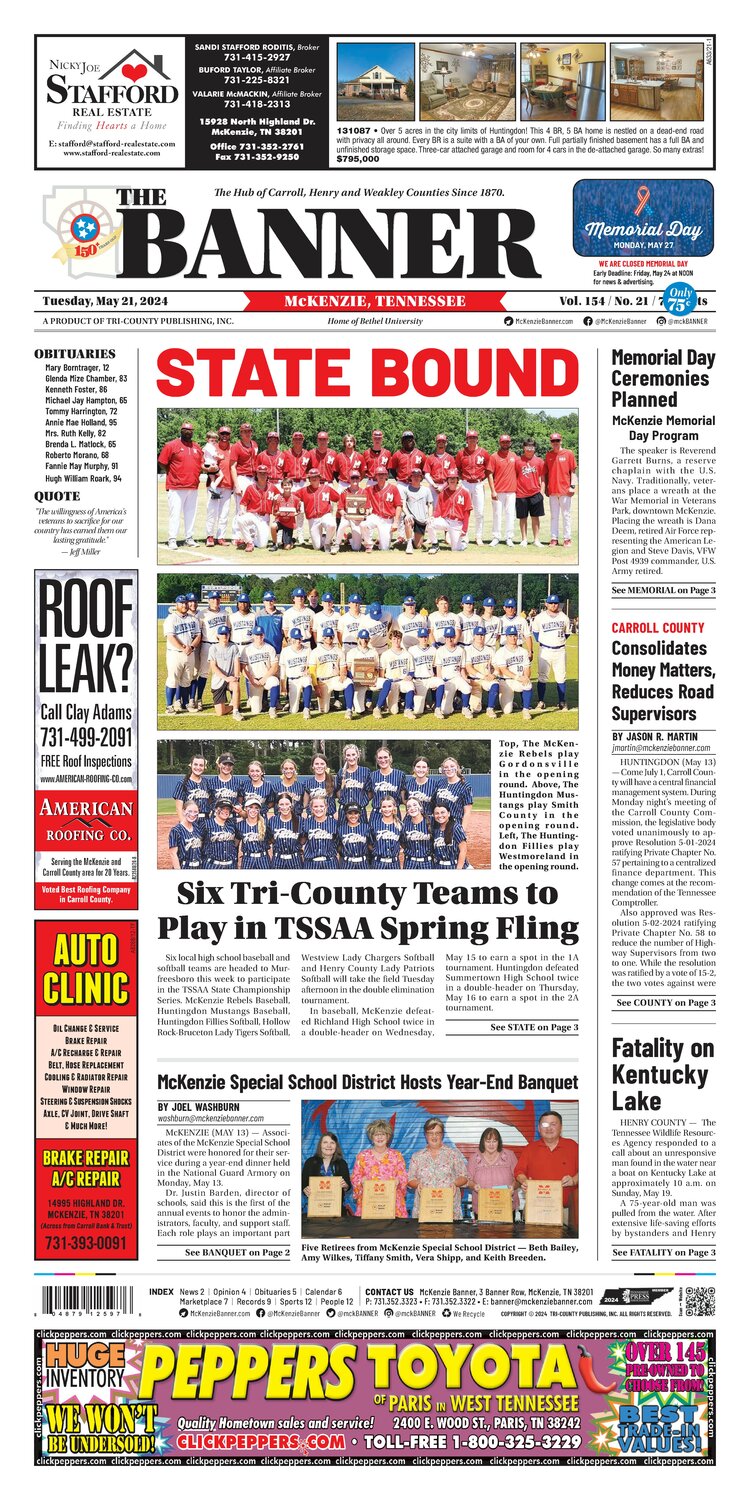
In the e-Edition
McKenzie Banner May 21, 2024
May 21, 2024 · Read the full issue →
Related Stories

Hunker Down with Kes: Come Watch the Parade with Me
For some, it might be the long-gone City Café. Or the Polar Bar. Or Freemen’s Menswear. Or maybe you remember buying some chocolate-covered peanuts at the Ben Franklin 5 & 10 Cent Store. Or a spiral notebook for going back to school from the Golden Rule. Or shopping for a Christmas toy in the basement of J. A. Abernathy’s Hardware…
Sep 8, 2026
Hunker Down with Kes: ‘Hello Again’ Was All She Said…
But she would say it each week with the most genuine smile I have ever witnessed. I couldn’t think of anything to say. She was a rising country music star. I was just hanging around backstage because Mr. Bud Wendell, the manager of the world-famous Grand Ole Opry, had taken a liking to me.
Sep 1, 2026

The Wit and Wisdom of David Johnson: The Ultimate Gamechanger
Before the world was breathed into existence, Holy Spirit, Christ, and Father contemplated the plan for mankind. At the forefront of their discussion was the means of redemption.
Sep 1, 2026
The Wit and Wisdom of David Johnson: Any Way You Measure it Camping is an Adventure
I could probably write a book solely devoted to my camping adventures and the crazy, wonderful, amazing, unexpected things that happened. I’d grown up camping with my family, but it was something brand-new for my wife. However, she became a devotee even when our two daughters were babies. Tents. Tents that leaked. That’s how we started out. Sleeping bags on the ground. Camping with no electricity, a bathhouse lit by a skylight, and cold showers.
Aug 25, 2026