

The Wit and Wisdom of David Johnson
‘Great Balls of Fire!’
From the Feb 10, 2026 e-EditionCuss words were never uttered in the family I grew up in.
I’m not saying no one ever thought of saying them because I’m guessing my mother and father had one or two pass through their mind while trying to raise me. I mean, my mother said to my older sister one time when talking about me, “I don’t know what I’m going to do with him.”
Yeah, I was that kid.
NONETHELESS, let’s get back to the subject. Whether cuss words were thought or not, they weren’t spoken because they weren’t allowed. That’s a pretty good rule, if you ask me. Mainly because cussing limits your vocabulary.
Honestly, there aren’t that many cuss words, just unlimited combinations of the same words, which, frankly, I find boring. It might surprise you to learn I’ve been “cussed out” (that’s an interesting expression, isn’t it?) lots of times. So much so, it has long since ceased to bother me. All I’m interested in is whether I hear a combination I’ve never heard.
I don’t mind when one of my clients uses cuss words to express themselves, because that’s their language and the only way they know how to express themselves. I respect that.
And I’m certainly not saying a word or two hasn’t slipped passed my lips on occasion, like when I recently told my wife she’s a “grown a$$ woman” and can do what she wants to do without worrying what other people will think. If you read my books, you’ll occasionally find one of the characters speaking rather loosely, only because that’s their vocabulary.
The main thing I want to do here is offer some help to those of you who are trying to expand your vocabulary. I’ve got a list of tried-and-true expressions that will fit any sort of situation filled with high emotion.
Using “dog” as a prefix works with lots of other words, like “Doggone your hide!” which you would use when a friend hits you with a water balloon. Or “Doggone it!” which is for the times your favorite team loses or a fish gets off your line.
If you prefer using a cat, you can say, “What in the cat hair?!” This is used to describe anything that defies explanation, like how your two-year-old boy stuck twenty-seven popcorn kernels up his nose.
The word “holy” gets used a lot, which is probably not wise, but nonetheless, there is “holy smoke” and “holy cow” used to describe surprise or dismay as when the Chicago Cubs win a baseball game.
“Dag” isn’t a word, but when you pair it with other words, as in “dagnabit” or “dagblasted” you end up with expressions to describe how you feel when realize you used plain flour instead of self-rising when you made biscuits.
Closely related to the “dag” words are “dadgum” and “dadburn.” That’s what a boy said to me after I’d placed a penny on the radiator for fifteen minutes during American History class and then set it on the back of his neck while he was bent over studying. He jerked upright, sending the penny sliding past his shirt collar and down his back. It wasn’t nearly as funny to him as it was to me.
If you don’t object to using “holy,” then you’ll probably be okay with using “heaven,” as in “heavens to Betsy” or “heaven help us.” You could use either one when you learn your octogenarian uncle has run off with a twenty-year-old. (But neither of those expressions would be what his wife would say.)
I can’t explain why, but you can say “gosh” or “gosh dang it” but not “gosh grief.” Just as you can say “good grief” but not “good dang it.”
There are unanswerable questions that make no sense, like, “What in tarnation?” or “What in the sam hill?” either of which can be used when you hear something go “bump” in the middle of the night.
The little word “for” is as handy as a Swiss army knife. “For crying out loud,” “forever more,” and “for Pete’s sake” can all be used when you’re exasperated over the power going out at the climatic moment of your favorite movie that you’ve seen a dozen times but keep hoping that this time the main character won’t make the same fatal mistake.
I especially like the sound of “yikes,” “thunderation,” “I’ll swahnee,” and “lawzee me.” They can mean anything you want them to.
“Confound it” works well when you’re looking for your phone that you’re holding in your hand or your glasses that you’re already wearing.
“Fiddlesticks” might be okay to use where you live but not around here, because there’s an annual Fiddlestick Festival held in Greenfield with corndogs and fried Oreos and rides designed to make you throw them up.
You might think “I declare” means you’re actually going to declare something, but the expression stands alone when used to express the feeling you have when you walk into your teenager’s room and find they’ve cleaned it without being told to. “Mercy sakes alive” also works well. But be prepared to say “land o’ Goshen” when that same teenager comes to you asking if they can use the family car to go mudding.
Saying “shoot fire” or “shoot a monkey” has nothing to do with a gun, but it’s what you say when you hit your thumb with a hammer for the umpteenth time.
And finally, you can use the word “my” if you say it more than once, like if you tell your wife, “My, my this is good banana pudding.” The power of the word increases exponentially, because if you say it three times, “My, my, my, honey, this is good banana pudding” you might get lucky in bed that night and be heard to exclaim, “Great balls of fire!”
* Taken from The Wit and Wisdom of David Johnson, Volume III: A Harrowing Halloween Tale
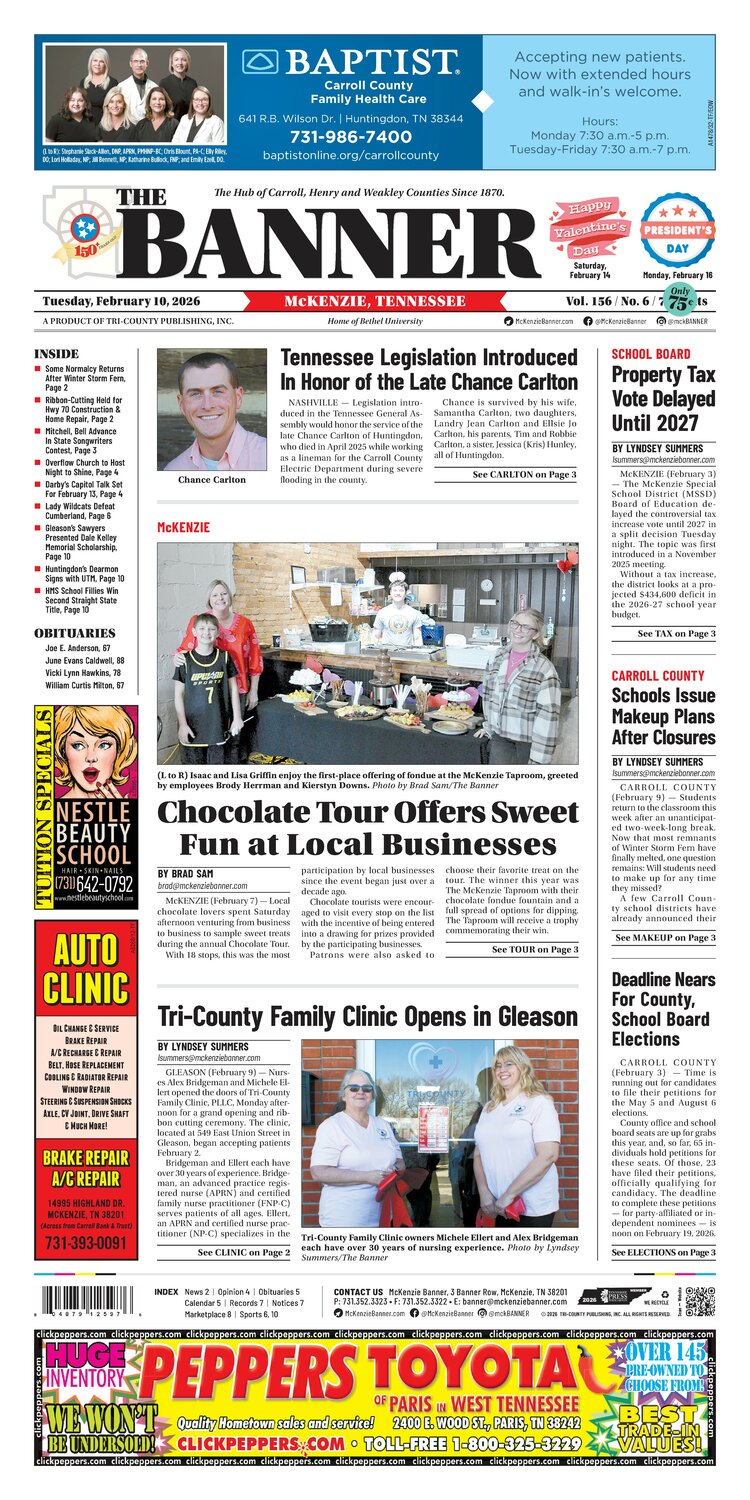
In the e-Edition
McKenzie Banner February 10, 2026
Feb 10, 2026 · Read the full issue →
Related Stories
Hunker Down with Kes: Come Watch the Parade with Me
For some, it might be the long-gone City Café. Or the Polar Bar. Or Freemen’s Menswear. Or maybe you remember buying some chocolate-covered peanuts at the Ben Franklin 5 & 10 Cent Store. Or a spiral notebook for going back to school from the Golden Rule. Or shopping for a Christmas toy in the basement of J. A. Abernathy’s Hardware…
Sep 8, 2026
Hunker Down with Kes: ‘Hello Again’ Was All She Said…
But she would say it each week with the most genuine smile I have ever witnessed. I couldn’t think of anything to say. She was a rising country music star. I was just hanging around backstage because Mr. Bud Wendell, the manager of the world-famous Grand Ole Opry, had taken a liking to me.
Sep 1, 2026

The Wit and Wisdom of David Johnson: The Ultimate Gamechanger
Before the world was breathed into existence, Holy Spirit, Christ, and Father contemplated the plan for mankind. At the forefront of their discussion was the means of redemption.
Sep 1, 2026
The Wit and Wisdom of David Johnson: Any Way You Measure it Camping is an Adventure
I could probably write a book solely devoted to my camping adventures and the crazy, wonderful, amazing, unexpected things that happened. I’d grown up camping with my family, but it was something brand-new for my wife. However, she became a devotee even when our two daughters were babies. Tents. Tents that leaked. That’s how we started out. Sleeping bags on the ground. Camping with no electricity, a bathhouse lit by a skylight, and cold showers.
Aug 25, 2026