
Congressman Kustoff Addresses McKenzie Rotary Club
From the Aug 5, 2025 e-Edition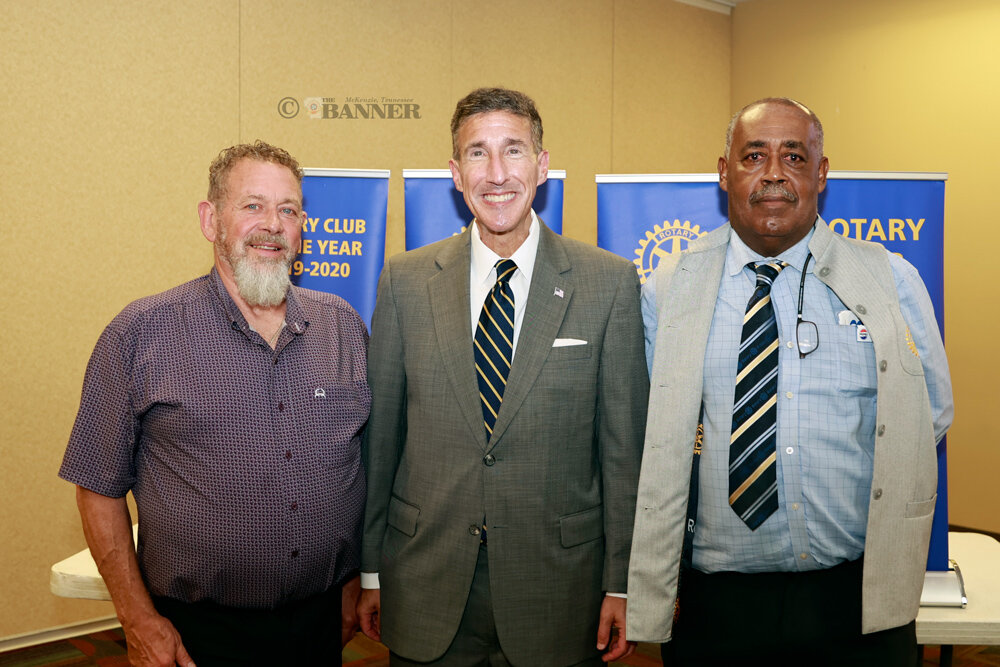
McKENZIE (July 29) — U.S. Congressman David Kustoff (R-Germantown) was the featured speaker at the Rotary Club of McKenzie on Tuesday, July 29, on the campus of Bethel University.
Kustoff was introduced by Rotary President Ricky Price. In a surprise announcement, Congressman Kustoff invited Dr. Ed Perkins to join him at the front of the room. Recently, the McKenzie Rotarians honored Perkins for his 65 years of service in the club. He is the longest-serving member, a former district governor, and heads the humanitarian fund managed by the club.
“Dr. Perkins, we want to recognize you for your 65 years of membership in Rotary. If my math is correct, that means you joined this club in 1960. So, first of all, thank you very much. This is a special Congressional recognition presented to Dr. Ed Perkins in acknowledgment of 65 years of dedicated public service to the McKenzie Rotary Club and the surrounding community. Congratulations on this remarkable milestone.” Dr. Perkins responded, “That’s too much, too much.” Kustoff continued, “We’re very proud of you. Thank you very much, and congratulations.”
The Congressman then spoke on a single issue: The One Big Beautiful Bill. “This has been a big priority for us in Congress and for President Trump. I’m going to take a moment to look back. In 2017, during my first year in Congress, we passed the Tax Cuts and Jobs Act. This legislation lowered everyone’s taxes, reduced individual tax rates, and doubled the standard deduction, allowing 90% of people in West Tennessee to take the standard deduction instead of itemizing. We provided tax breaks for small businesses, lowered the corporate tax rate, and doubled the estate tax exemption to relieve most families from paying taxes when a loved one passes away. If we do not act by the end of this year, many of these tax provisions will expire and revert to the previous rates.”
The Congressman credited much of the economic success to the passage of the Tax Cuts and Jobs Act.
DOGE exposed a number of spending ills and misspending and overspending, that frankly, it was very helpful. And I’m being candid with you. They found things that I didn’t talk about, which is good. I’m not trying to oversimplify this. We don’t have a revenue problem in this country. We’ve got a spending problem. Even when we lowered taxes in 2017, we saw revenues to the U.S. Treasury increase. And that’s because people were doing better. People made more money, businesses made more money, and they were paying a lower rate, but they were ultimately paying more money. We also saw during those years, especially during the COVID years, that the spending increased exponentially.
Addressing the lack of domestic manufacturing, Congressman Kustoff said the nation learned during COVID, one thing we found, a lot of us discovered this, a lot of what we consume is not produced in the United States.
Medicine, pharmaceuticals, what happens if the supply chain shuts down again and we need antibiotics and cancer drugs that are made in other places. So the goal of these trade deals is, number one, even the playing field, and two to incentivize manufacturing in the U.S. We’ve done part of that through the one big, beautiful building. So you’re seeing a lot of trade deals being negotiated. You go back a few months ago, April 2, the president announced tariffs on countries around the world. Later on April 19, he paused it until August 1.
As a parting gift, Rotary President Ricky Price presented Congressman Kustoff with a box of cookies imprinted with the Congressman’s photograph.
“I serve on the House Ways and Means Committee, the oldest committee in Congress and the only one mentioned in our Constitution. This committee has jurisdiction over all things tax. The One Big Beautiful Bill encompasses more than just tax; it includes border security and agriculture, but the tax portion is under my committee’s purview. We have been working on drafting this legislation.
During hearings, I questioned Treasury Secretary Bessent about the consequences if Congress failed to pass the bill. The Secretary warned that it would lead to a catastrophic event for working Americans and the financial system, resulting in the largest tax increase in history when taxes reverted to the rates and policies that existed before 2017.”
Kustoff noted that the passage of the bill involved numerous obstacles. Discussions began in May, and the bill was signed by President Trump on July 4. He described the committee debate as intense: starting at 2:30 a.m. on Tuesday and concluding Wednesday morning at 8 a.m. After passing the House of Representatives, the bill advanced to the Senate, which passed a different version. It then returned to the House for confirmation before finally reaching the President on Independence Day for his signature.
“I was invited to the White House for a signing ceremony on July 4 to witness this legislation being enacted into law, which was a truly special experience. In my opinion, we are doing a lot of good things for the country.”
The Congressman also mentioned that one of his bills was approved, allowing taxpayers adversely affected by natural disasters to postpone filing their federal tax returns. “I was in the Oval Office when the President signed the bill.”
Kustoff recounted his experiences in Las Vegas, where he spoke about the tax relief granted to those who earn a significant portion of their income from tips. This legislation also provides tax relief for individuals earning overtime wages, reducing the tax burden on that income and encouraging employees to work more than 40 hours without facing additional taxes.
“I wanted to share some of the accomplishments of the One Big Beautiful Bill. One significant change is that individuals who primarily earn their income from tips will no longer have to pay taxes on those earnings. Additionally, overtime earnings will also be tax-exempt.”
During a hearing held at the Yes Co Sign Factory, which produces neon signs, a plant foreman testified that this change would encourage younger employees to work overtime, allowing them to earn more while retaining a larger portion of their income. Hearing this testimony validated my legislative efforts.
We also heard from a woman who works as a DoorDash driver. She mentioned that she is the sole breadwinner for her family and that her husband is undergoing medical treatments. The tax-free provision on tips will help her.
The following day, we held a field hearing at the Ronald Reagan Presidential Library...We had several witnesses at that hearing as well. One was a man who owns convenience stores and office buildings. We made the small business deduction permanent, allowing a 20% deduction. He expressed that this change would enable him to open more stores, hire more employees, and increase wages.
I also spoke with Jay Timmons, the head of the National Association of Manufacturers. He discussed how the tax breaks we’re providing to both large and small manufacturers would enable them to hire more staff. Business is thriving right now, and many people feel good about the economy thanks to the “one big, beautiful bill.” Hearing these testimonials truly made me feel accomplished.
Another important point is that we made the estate tax exemption permanent, raising it to $15 million for individuals and double that for married couples. I strongly believe that no one should have to pay estate taxes when a loved one passes away. In Tennessee, the state government has already eliminated the estate tax, which has led to an influx of people moving here from other states.
I think a lot about family farms and small businesses. If the estate tax exemption had been lowered, as it was previously to $5 million or $6 million, many farms and small businesses would face severe difficulties upon the death of their owners. One cattleman who testified shared that by raising the exemption to $15 million, it not only protects him but also saves individuals like him from incurring significant legal fees to create trusts to protect their assets for their families. That insight was quite satisfying.
We will continue to work hard for what I believe are common-sense solutions. I wanted to highlight the “one big, beautiful bill” so you could understand what Congress has been working on during the first six months of this year.
To a question about whether overtime or double-time pay is taxed at the same rate as regular time, or is it not taxed at all,
Kustoff said, “It’s not taxed at all. It’s actually an above-the-line deduction that won’t be taxed. At some point, based on your earnings, there will be a phase-out, but there won’t be any tax.
More Photos & Video
In the e-Edition
McKenzie Banner August 5, 2025
Aug 5, 2025 · Read the full issue →
Related Stories

Ribbon Cutting Held for Mulberry Park Soccer Complex
McKENZIE (September 12) — The City of McKenzie held a ribbon cutting on Saturday, September 12 for the new soccer complex at Mulberry Park in McKenzie. Early morning saw several soccer matches on the new fields. The ribbon cutting ceremony took place at noon with several city officials and community members present.
Sep 15, 2026
Heritage Festival is September 19
The Huntingdon Heritage Festival returns to downtown Huntingdon on Saturday, September 19, 2026, bringing a full day of free family entertainment, local shopping, food, arts and activities, and live music to the community.
Sep 15, 2026
Review of Homecoming '86, 2006 Baseball Championship to Be Held at Park Theatre
The historic Park Theatre in downtown McKenzie is the venue for two events during the McKenzie High School Alumni Association’s Decades Reunion weekend, September 25 and 26, 2026.
Sep 15, 2026
Inglenook Book Club Elects 2027 Officers
McKENZIE — The Inglenook Book Club gathered for its monthly meeting on September 9 at Lakeside in McKenzie. President Gail Mack called the meeting to order, leading members in the Pledge of Allegiance, the Club Aim, and the Club Motto. Fourteen members responded to the roll call.
Sep 15, 2026