

Weekly 150: Black Wednesday
Spreading Sunshine on Knox County
From the May 21, 2024 e-Edition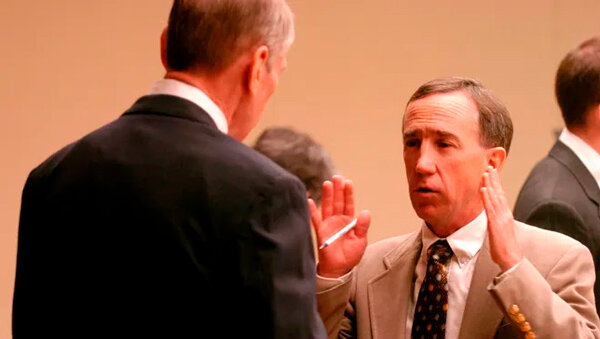
One of the greatest interventions by a news organization was by Jack McElroy of the Knoxville News Sentinel and the violation of the Sunshine Law by the Knox County Commission.
On January 31, 2007, Knox County Commission thought they were above the law or at least sunshine law. A meeting was called to fill 12 seats for outgoing county positions in Knox County, Tennessee.
The Commission meeting devolved into a string of recesses, with small groups meeting in the corners of the room. Those meetings led to the appointments of the friends, family members and political cronies of elected officials who were being removed from office.
That was Jan. 31, 2007. The meeting was called two weeks after the Tennessee State Supreme Court decided that, despite deficiencies identified in the charter, a term limits provision should be enforced. That meant the ouster of longtime officeholders. In all, a dozen elected officials — Sheriff Tim Hutchison, Register of Deeds Steve Hall, Trustee Mike Lowe, County Clerk Mike Padgett and Commissioners Mark Cawood, John Griess, John Mills, Diane Jordan, Larry Clark, Billy Tindell, Phil Guthe and John Schmid — had to go.
The workings of that meeting, dubbed Black Wednesday, grabbed national attention and led to a judge’s ruling that then nullified appointments. A citizen initiative ultimately reduced the size of the Knox County Commission from 19 to 11 members.
Knox County Mayor Mike Ragsdale said of the event, “I walked out of my meeting and Dwight Van de Vate called and said, ‘You might want to come back down here, and miss lunch’, Van de Vate was Ragsdale’s chief administrative officer at the time.
“It had gotten to be a pretty contentious situation,” Ragsdale said. “Some people were going to get (appointed), getting sworn in, and then coming back to the meeting and trying to vote.”
Van de Vate said that he recalled at least one commissioner on a phone call during a recess, avoiding conversation from lobbying influences. Van de Vate would later learn that the commissioner was faking the phone call.
“In 30 years of public life it was a moment of the greatest tension that I had ever seen,” Van de Vate said in an interview, “and it still is today.”
In a trial, u
nder oath, several commissioners would later tell a court that they talked to each other privately about nominees before the January 31 meeting and during breaks.
After witnessing the appointments in an hours-long meeting, local resident Jamie Rowe recalled a moment alone in the commission meeting room that January.
Shortly after that day, the News Sentinel filed a lawsuit, which was later merged with a suit by a group of citizens. A court would eventually determine that the county mishandled the appointments and force them to be done again.
Commission Chairman Scott Moore said, “I was trying to do everything possible for no conflict.” He said there were no backroom dealings that day.
“There was no such thing as a backroom deal ... it happened right there at the county commission, and it happened like it was supposed to,” Moore said.
“Until Black Wednesday had happened ... nobody had questioned the practice. What they couldn’t do was get together in groups of 10 or more outside of the public eye. They could gather in clumps of two or three,” said Michael Moyers, a Chancery Court judge in Knox County.
Under the scrutiny of a lawsuit after Black Wednesday, a court would determine that the way commissioners carried out Moyers’ advice was not adequate.
The judgment forcing reappointments came months after Black Wednesday.
On October 6, 2007, Knox County Chancellor Daryl R. Fansler nullified the 12 appointments made by the Knox County Commission and threatened commissioners with criminal contempt charges if they deliberated in private again.
A year later, Moore would be ousted himself on perjury. Special Judge Jon Kerry Blackwood, “When the judicial process is itself subverted for political gain, the courtroom must take cognizance of these transgressions,” the judge said. “The essence of our judicial system is our ephemeral search for the truth. When that solemn oath is violated, judicial consequences must follow.”
The tumult in 2007 led to a ballot the next year that had 73 people file for 19 open offices.
Ragsdale said that in his final term as mayor, the 19-seat Board of Commissioners saw 41 different people hold office.
The happenings of Black Wednesday left Knox County with a black eye and a win for Tennessee and the Sunshine Law. This stands as a reminder and warning to all groups that think they are above the law. The job of government is to represent the people. Conducting government business in private is not only illegal but also shows a group's true character.
*The majority of the information above was sourced and provided by Gerald Witt with the Knoxville News Sentinel.

In the e-Edition
McKenzie Banner May 21, 2024
May 21, 2024 · Read the full issue →
Related Stories

Hunker Down with Kes: Come Watch the Parade with Me
For some, it might be the long-gone City Café. Or the Polar Bar. Or Freemen’s Menswear. Or maybe you remember buying some chocolate-covered peanuts at the Ben Franklin 5 & 10 Cent Store. Or a spiral notebook for going back to school from the Golden Rule. Or shopping for a Christmas toy in the basement of J. A. Abernathy’s Hardware…
Sep 8, 2026
Hunker Down with Kes: ‘Hello Again’ Was All She Said…
But she would say it each week with the most genuine smile I have ever witnessed. I couldn’t think of anything to say. She was a rising country music star. I was just hanging around backstage because Mr. Bud Wendell, the manager of the world-famous Grand Ole Opry, had taken a liking to me.
Sep 1, 2026

The Wit and Wisdom of David Johnson: The Ultimate Gamechanger
Before the world was breathed into existence, Holy Spirit, Christ, and Father contemplated the plan for mankind. At the forefront of their discussion was the means of redemption.
Sep 1, 2026
The Wit and Wisdom of David Johnson: Any Way You Measure it Camping is an Adventure
I could probably write a book solely devoted to my camping adventures and the crazy, wonderful, amazing, unexpected things that happened. I’d grown up camping with my family, but it was something brand-new for my wife. However, she became a devotee even when our two daughters were babies. Tents. Tents that leaked. That’s how we started out. Sleeping bags on the ground. Camping with no electricity, a bathhouse lit by a skylight, and cold showers.
Aug 25, 2026