
Weekly 150: Morris Frank
The Seeing Eye Dog Program
From the Jun 18, 2024 e-Edition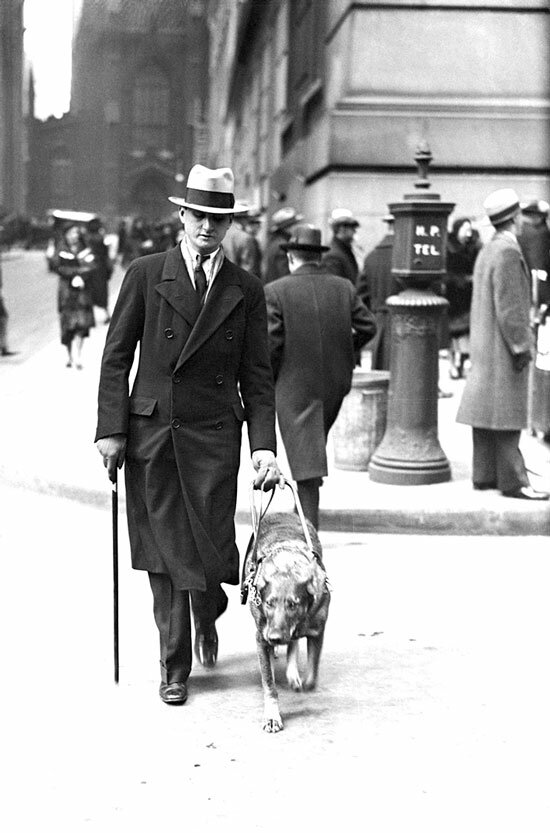
Morris Frank was a blind man who helped start the first school that trained seeing eye dogs. His dog Buddy is considered to be the first seeing eye dog in America.
In 1914, at the age of 6, Morris Frank was blinded in his right eye in a horse-riding accident. Ten years later, a boxing match cost him the sight in his left eye.
This amazing story started in 1927, when Morris Frank was a 20-year-old student at Vanderbilt University and a man unhappy about his dependency on others to get around.
Frank’s father read him an article by Dorothy Eustis, a woman living in Switzerland who had seen shepherds training dogs to help blind people get around.
German specialists had been working at this time, on the use of Alsatians (German Shepherds), to act as guide dogs for WWI veterans blinded by mustard gas.
Excited by the idea, Frank took a ship to Europe and trained extensively with a dog, Buddy, that had been bred specifically to lead a blind person. The training was hard. But after weeks with the dog, He described as dog as “the divine gift of freedom.”
Frank could get around the nearby village holding tightly to a harness to which Buddy was strapped.
Morris Frank returned to America with a goal of spreading the word about seeing eye dogs. From the day he got off the ship, he was successful. At one point, in front of a group of reporters, Buddy led Frank safely across a busy New York street.
When Frank returned to Nashville, people were amazed at the sight of the blind man and his dog successfully navigating busy sidewalks. “Now strangers spoke freely to me,” Frank wrote years later. “In the old days, I often envied two sighted persons, who obviously did not know each other, their ease in striking up a conversation. With Buddy there, however, it was the easiest and most natural thing in the world for them to say, ‘What a lovely dog you have!’”
About this time, Frank, Eustis and several others co-founded The Seeing Eye, an institution set up to train guide dogs and their blind masters. It operated in Nashville for two years and then moved to Morristown, NJ.
Frank told a New York Times interviewer in 1936 that he had probably logged 50,000 miles with Buddy, by foot, train, subway, bus, and boat. He was constantly meeting with people, including two Presidents and over 300 ophthalmologists, demonstrating the life-changing qualities of owning a guide dog.
Buddy’s health was failing in the end, but the team had one more hurdle to cross. One more barrier to break. Frank wanted to fly in a commercial airplane with his guide dog. The pair did so on this day in 1938, flying from Chicago to Newark, Buddy curled up at Morris Frank’s feet.
United Air Lines was the first to adopt the policy, granting “all Seeing Eye dogs the privilege of riding with their masters in the cabins of any of our regularly scheduled planes.” Buddy remained a national hero for the rest of his life. When the dog died in May 1938, the event was noted with obituaries that were published all over the country.
Today, the Seeing Eye reports that it has trained 14,000 dogs. Buddy was the first. Some 250 dogs — mostly German shepherds, Labrador retrievers and golden retrievers — complete training at the Seeing Eye in Morristown, NJ, every year.
In the e-Edition
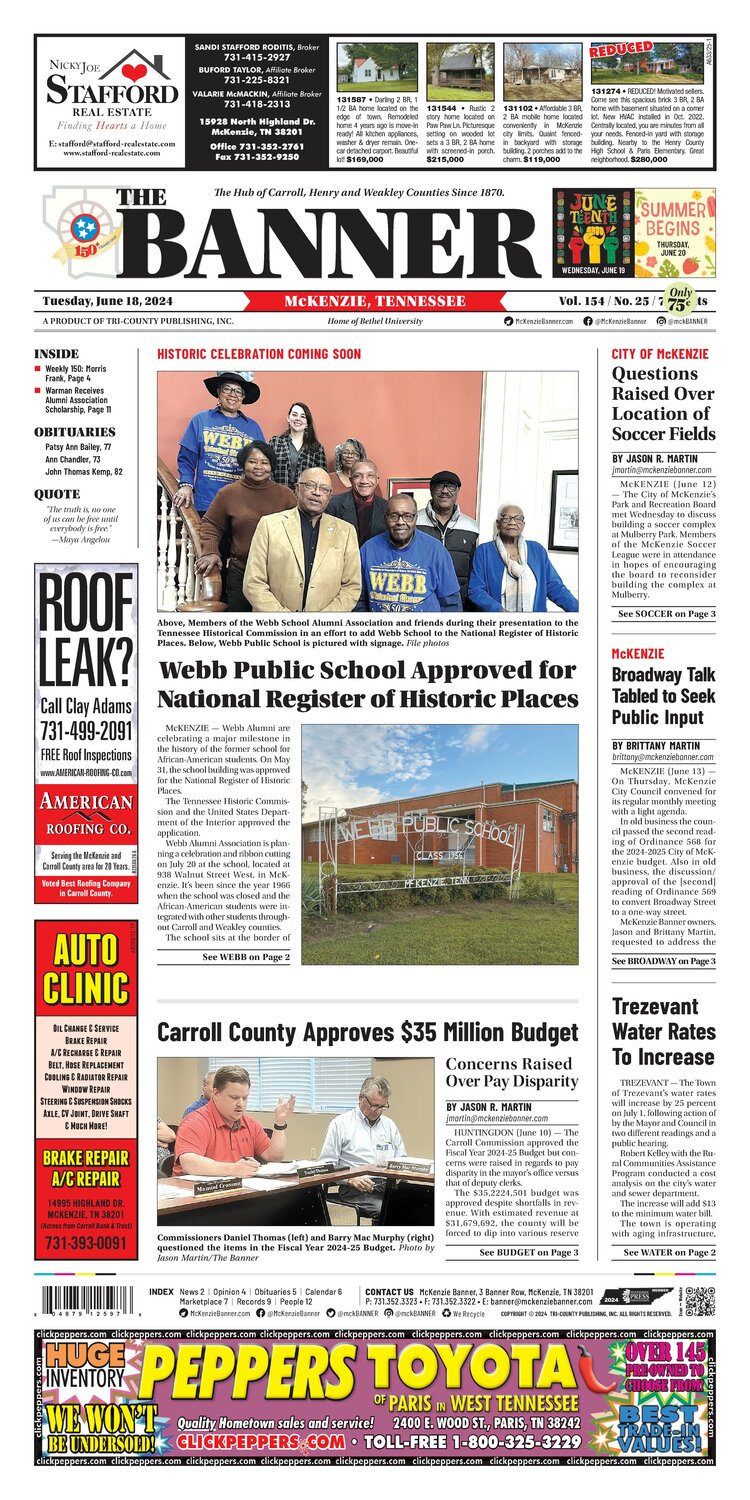
McKenzie Banner June 18, 2024
Jun 18, 2024 · Read the full issue →
Related Stories
Hunker Down with Kes: Come Watch the Parade with Me
For some, it might be the long-gone City Café. Or the Polar Bar. Or Freemen’s Menswear. Or maybe you remember buying some chocolate-covered peanuts at the Ben Franklin 5 & 10 Cent Store. Or a spiral notebook for going back to school from the Golden Rule. Or shopping for a Christmas toy in the basement of J. A. Abernathy’s Hardware…
Sep 8, 2026
Hunker Down with Kes: ‘Hello Again’ Was All She Said…
But she would say it each week with the most genuine smile I have ever witnessed. I couldn’t think of anything to say. She was a rising country music star. I was just hanging around backstage because Mr. Bud Wendell, the manager of the world-famous Grand Ole Opry, had taken a liking to me.
Sep 1, 2026

The Wit and Wisdom of David Johnson: The Ultimate Gamechanger
Before the world was breathed into existence, Holy Spirit, Christ, and Father contemplated the plan for mankind. At the forefront of their discussion was the means of redemption.
Sep 1, 2026
The Wit and Wisdom of David Johnson: Any Way You Measure it Camping is an Adventure
I could probably write a book solely devoted to my camping adventures and the crazy, wonderful, amazing, unexpected things that happened. I’d grown up camping with my family, but it was something brand-new for my wife. However, she became a devotee even when our two daughters were babies. Tents. Tents that leaked. That’s how we started out. Sleeping bags on the ground. Camping with no electricity, a bathhouse lit by a skylight, and cold showers.
Aug 25, 2026