

Commissioner Andy Holt Details $103.8 Billion Industry, Tackles Farm Challenges at McKenzie Rotary Club
From the Apr 7, 2026 e-Edition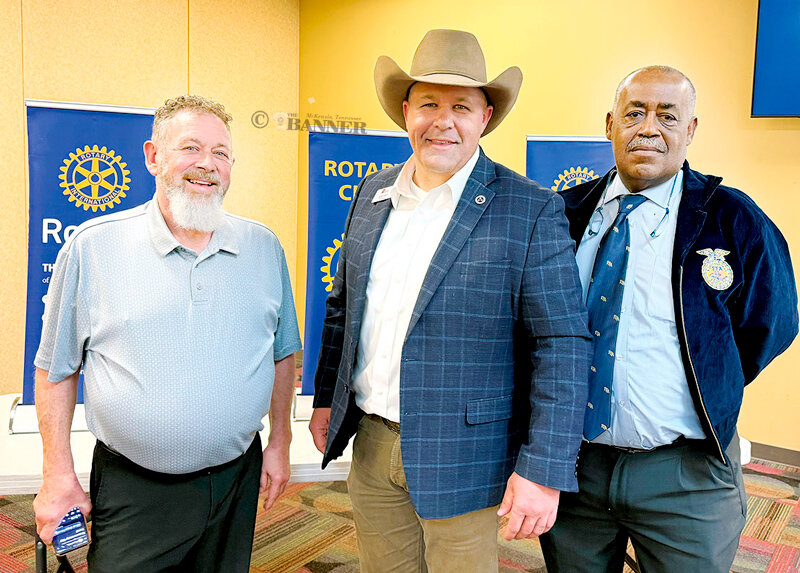
Mr. Andy Holt, Tennessee Commissioner of Agriculture, spoke to the McKenzie Rotary Club on Tuesday, March 31, detailing the significant economic force of agriculture and forestry in the state, his priorities for the department, and major challenges facing Tennessee farmers.
The McKenzie Rotary Club meets each Tuesday at noon, at Bethel University.
Holt, a Dresden, Tenn., resident and first-generation farmer, described his path to the role as unlikely. He was born into a poverty-stricken home in a Knoxville ghetto where education was not a priority. He learned to read in the second grade when his teacher, Ms. Parker, kept him from recess and taught him using books about agriculture, which led him to decide he would be a farmer, despite having never stepped foot on a farm.
Before becoming commissioner last October, Holt represented the area in the Tennessee General Assembly as a member of the House of Representatives from 2010 to 2020. He then worked his way up through the Department of Agriculture, serving as a manager, director, assistant commissioner, and deputy commissioner before being named Commissioner by Governor Lee.
Holt emphasized that agriculture and forestry combined constitute Tennessee’s largest industry category, totaling $103.8 billion. This figure is more than triple that of the state’s next-largest industry, tourism, which is valued at $32 billion. The state has approximately 69,000 farms, with an average size of 152 acres.
Over 50% (52–53%) of Tennessee is covered in forested material, 80% of which is hardwood. Tennessee, alongside Kentucky and Missouri, is one of the top three states selling hardwood, and is considered the world’s most sustainable hardwood producer. He also highlighted that, apart from the Amazon, the Great Smoky Mountains National Forest is the second most biodiverse spot globally. The state’s top commodities are soybean, corn, cattle, and forest products.
Holt outlined key priorities for the Department of Agriculture:
Increased Access to Markets (Domestic and International): He mentioned visiting 11 countries in the last 18 months, focusing on emerging markets such as India, Vietnam, and Morocco to sell Tennessee products, including hardwood, grain, livestock, and genetics.
In-State Value Creation, Development, and Diversification: Holt advocates for re-establishing the priority of natural and sustainable materials, such as wood fiber, cotton, and linen, in daily life over cheap, plastic alternatives.
Increased Interaction with Non-Agricultural Public: Since the average American is two or three generations removed from direct agricultural exposure, he views his job as advocating for agriculture to people who do not farm. He encouraged children to visit working farms. Holt operates a farm in Weakley County and hosts groups and individuals to visit.
The Commissioner addressed the significant economic pressures facing the industry:
Row Crop Economics: Farmers are being squeezed by extremely high input prices—including fertilizer, energy, seed, and chemicals—coupled with relatively low prices for their products on global markets.
Projected Losses: The estimated loss in Tennessee on four major crops—cotton, soybean, corn, and wheat—was $492 million in 2025 alone, with the vast majority of that loss occurring in West Tennessee. Projected losses per acre included $409 for cotton, $184 for soybeans, $125 for corn, and $23 for wheat.
Land Conversion: Tennessee is arguably the second or third worst state in the nation right now, for land conversion, from agricultural and forested land into non-agricultural use.
White-Tailed Deer Overpopulation: This issue is having a strong negative impact on agriculture by eating young crops, is causing “hundreds of millions of dollars” in automobile insurance costs annually, and is contributing to high amounts of coliform and E. coli found in natural waterways.
Holt concluded by discussing consumer-driven food trends, noting that the “Make America Healthy Again” (MAHA) focus has led to a greater emphasis on preventive health and chronic disease awareness. He added that agriculture must meet the demands of consumers, noting current trends toward clean and simple baking, increased protein and fiber consumption, and reduced processed foods. He explained that the high price of beef is due to the long production lag of 18 to 24 months, compared to 5 weeks for chicken or 5 months for pork.
He encouraged attendees to visit the Tennessee Products website for locally made artisan products.
I would encourage you if you’re looking for whether holiday gifts, something special that you want to buy for somebody, you want to show something appreciation, I would encourage you to look at our Tennessee products website, and that website can direct you to local producers, all across the state over 3,000 producers that can help me find artisan products that are made right here in the state of Tennessee.
More Photos & Video

In the e-Edition
McKenzie Banner April 7, 2026
Apr 7, 2026 · Read the full issue →
Related Stories

Glow Walk to Bring Awareness, Prevention of Suicide
McKENZIE, Tenn — The Carroll County Health Council, in partnership with Bethel University, will host a Suicide Prevention Glow Walk on Tuesday, Sept. 22, at 7 p.m. to raise awareness and bring community members together in support of suicide prevention.
Sep 13, 2026

Cash Express Honors McKenzie’s First Responders
McKENZIE (September 11) — On Friday, Cash Express honored McKenzie Police (MPD), McKenzie Fire & Rescue (MFD), and Baptist-Carroll County Ambulance first responders with cakes decorated with the American flag and cards signed by McKenzie businesses thanking them for their…
Sep 11, 2026

Wallace and Company Delights Crowd at Park Theatre
McKENZIE (September 3) — The Nights on Broadway concert series relocated inside the historic Park Theatre to beat the heat on Thursday. Wallace and Company delighted the crowd with a mix of classic rock and country music on the McKenzie Banking Company stage. Audience members…
Sep 8, 2026
Paris Landing Arts and Crafts Festival is September 12-13
The 26th annual Paris Lakeway Kiwanis Club Arts and Crafts Festival at Paris Landing State Park features over 115 local and regional crafters displaying and selling their handmade and hand-crafted items. The setting at Paris Landing State Park provides visitors with great views while shopping. There will also be food and beverage vendors, as well as a petting zoo. Admission and parking are free.
Sep 8, 2026